
Heat pumps designed around your home
An air source heat pump can heat a house very well — but only when the rest of the system is designed to suit it. This page explains what one actually does, where it works well, and what usually needs checking first.
What an air source heat pump does
It takes heat out of the outside air and moves it into your home’s heating and hot water. It does not burn anything. Because it moves heat rather than making it, it delivers several units of heat for each unit of electricity it uses.
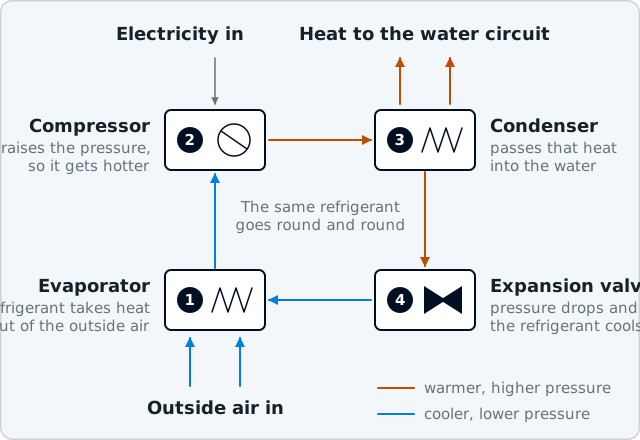
Inside the outdoor unit, a fan draws air across a heat exchanger containing a refrigerant that boils at a very low temperature. The refrigerant takes up heat from the air, a compressor raises its pressure and therefore its temperature, and a second heat exchanger passes that heat into the water going round your heating system. The refrigerant expands, cools, and goes round again. It is the same principle as a fridge, working in the useful direction.
The trade-off is temperature. A gas boiler happily pushes water round at 70 °C or more. A heat pump is at its most efficient at much lower flow temperatures, so the radiators or underfloor pipework have to be able to give out enough heat at that lower temperature. That single fact drives most of what a survey looks at.
It is also why a heat pump is not a like-for-like swap. The unit in the garden is the easy part. The design work is in the rest of the system.
How it differs from a boiler
Most of the surprises people report come from expecting a heat pump to behave like a boiler. It does not, and the differences are worth knowing before you decide.
| What changes | Gas or oil boiler | Air source heat pump |
|---|---|---|
| Where the heat comes from | Burning fuel in the house | Heat moved from the outside air by electricity |
| Flow temperature | Typically 65 to 80 °C | Designed as low as the emitters allow, and varied with the weather |
| Radiators | Sized for hot water, so often small | Sized for cooler water, so some rooms need larger emitters |
| How it runs | Short bursts at high output | Longer, steadier running at low output |
| Hot water | Often heated on demand by a combination boiler | Heated into a store, so hot-water storage is needed — usually a cylinder, or compact thermal storage where one will not fit |
| Outside the house | A flue | An outdoor unit needing air flow, drainage and service access |
| Electrical supply | A small load | A substantial load, so the supply and consumer unit are checked |
| Annual check | Gas safety check and service | No gas check, but an annual service that protects efficiency and warranty |
Your house will probably feel steadier
Instead of warming up quickly and then cooling, the house tends to sit at a consistent temperature. Radiators feel cooler to the touch than you are used to, which is normal and not a sign of underperformance.
Who this suits, and who it does not
Airwarm is a good fit for households who want the heating designed for the property, and who are willing to hear that a room needs a bigger radiator before they hear a price. It is a poor fit for anyone who wants the cheapest possible swap with nothing else changed.
That is not a judgement. It is a difference in what the two jobs are, and knowing which one you want saves everybody time.
A heat pump is often a particularly strong option where the current system is oil, LPG, storage heaters or direct electric, and where a boiler is close to the end of its life and something has to be decided anyway.
This suits you if
- You want the heating designed for the property, not a standard package
- You would consider radiator or fabric improvements where they are genuinely needed
- You are replacing oil, LPG, storage heaters or an ageing boiler
- You are renovating, and the heating can be planned alongside the building work
- You want the calculations, not a headline claim
It probably does not suit you if
- You want the cheapest possible unit fitted with nothing else touched
- Nothing about the emitters or the hot water can change
- You need the work done before a survey could realistically happen
If that is you, we would rather say so now than take a deposit and disappoint you later.
The five things that decide whether a heat pump will work well
In roughly this order of importance. None of them is exotic, and all of them are checkable.
Building fabric
How much heat the house loses sets everything else: the size of the heat pump, the size of the radiators and the running cost. Loft insulation, wall construction, draughts and glazing all matter. Older solid-wall stone housing — common across Bradford and Airedale — is not automatically unsuitable, but it does need assessing rather than assuming.
Radiators or underfloor heating
Emitters sized for a boiler are often too small for lower flow temperatures. Some rooms may need a larger radiator; others may be fine as they are. This is measured room by room, not guessed, and it is the most common reason a system underperforms when it is done badly.
Hot water
Heat pumps normally heat domestic hot water into a store rather than producing it on demand like a combination boiler. A conventional cylinder is the usual arrangement; where one will not fit, compact thermal storage may be considered as part of the design. Capacity still has to match how your household actually uses hot water — which is why the survey asks about your routine rather than simply counting bedrooms.
The outdoor unit
The unit needs a position with free air flow, sensible pipe and condensate routes, tolerable noise for you and your neighbours, and safe access for servicing. Terraces with no rear access, tight side passages and shared yards all need thinking about early.
Controls and how you live
Heat pumps prefer steady, gentle running to short blasts. Weather compensation, sensible setback and a system that has been balanced make a real difference. So does knowing how the household actually uses the house — which rooms matter, and when.
And the electrical supply
A heat pump is a substantial electrical load, so the incoming supply, main fuse and consumer unit are all checked at survey. Electrical work is carried out by appropriately qualified regional electrical contractors working to Airwarm’s design and coordination, and where the network operator needs to be involved Airwarm will say so early.
What a complete system looks like
People picture the box in the garden. In practice a heat pump installation is five things working together, and the quality of the result depends on all of them.
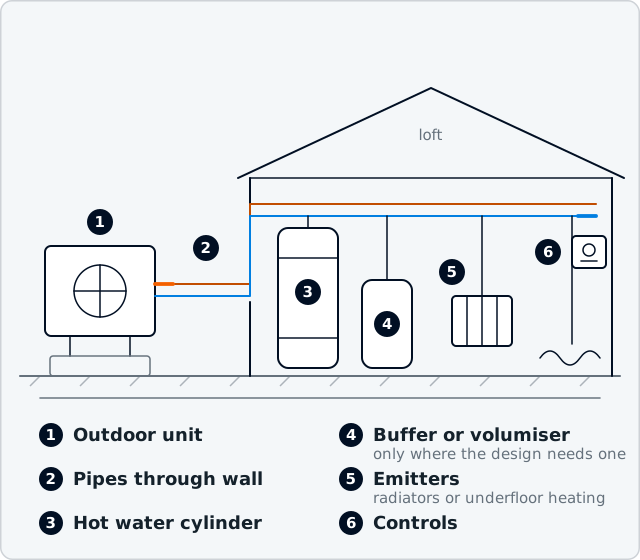
- The outdoor unit. Sized from the heat loss calculation, positioned for air flow, noise and service access, mounted clear of the ground with a route for condensate to drain safely.
- The cylinder. Sized for your household’s actual hot water pattern, with a coil large enough for a heat pump rather than a boiler, and placed where the pipe runs are short and serviceable.
- The emitters. Radiators or underfloor circuits checked room by room against the design flow temperature. Some are already adequate; some need to be larger.
- The controls. Weather compensation set from the heat loss calculation, configured at commissioning and refined during the first season — not left on factory defaults.
- The hydraulics. Pipe sizes, flow rates and balancing. Unglamorous, invisible, and one of the commonest reasons a system that looks right on paper disappoints in the house.
- And sometimes solar. Solar will contribute, mostly outside the heating season and mostly to hot water. If you are considering both, it is worth planning them together.
Airwarm’s survey-led approach
We do not quote from a phone call and a postcode. The order is always: assess, discuss, survey where it is justified, design, then propose. Each stage gives you a decision point and gives us something we can stand behind.
Every proposal is reviewed for heat loss, emitter capacity, flow temperature, hydraulic arrangement, hot water, controls, electrical requirements, siting, noise and commercial scope before it is issued to you.
You get the assumptions as well as the answers. If a calculation matters to your decision, you are entitled to see what went into it.
What an installation includes
- Room-by-room heat loss and emitter design
- Heat pump, cylinder and hydraulic arrangement
- Radiator or underfloor emitter upgrades where required
- Controls and weather compensation set up properly
- Flushing, filling, pressure testing and balancing
- Commissioning records and a plain-English handover
- Warranty details and a service schedule
Frequently asked questions
Will a heat pump work in my house?
Most homes can be heated well by a heat pump, though not every home today and not every home without changes. What actually decides it.
Do heat pumps work in cold weather?
Yes. Air source heat pumps extract heat from outside air well below freezing. Efficiency reduces as it gets colder, and demand rises at the same time, so consumption is highest in the coldest weather. The system is sized for a cold design day rather than an average one.
Will my house feel different?
Usually it feels steadier. Instead of warming up quickly and then cooling, the house tends to sit at a consistent temperature. Radiators feel cooler to the touch than you are used to, which is normal and not a sign of underperformance.
Do I need a big garden?
No, but the outdoor unit needs enough free air around it, a route for condensate drainage, service access, and an acceptable noise level at neighbouring windows. Small yards and narrow side passages are often workable; the survey checks the specifics rather than applying a rule.
Where will the outdoor unit go?
Somewhere with adequate air flow, service access, a condensate drainage route and an acceptable noise level at the nearest neighbouring habitable room window. The survey assesses candidate positions and explains the reasoning for the one recommended, including any trade-off with appearance.
Will it be noisy for my neighbours?
The noise level at the nearest neighbouring window is assessed as part of the design, and it is a condition of the permitted development route. Position and mounting matter more than the equipment. Airwarm would rather discuss a position that works for the neighbours at survey stage than deal with a complaint afterwards.
Do I need planning permission?
Many domestic air source heat pump installations in England proceed under permitted development, subject to conditions including a noise assessment. Flats, listed buildings and conservation areas are more restricted. Airwarm will tell you what applies to your property and where a planning application would be needed.
My property is listed or in a conservation area. What changes?
Permitted development rights are restricted or removed, so consent is likely to be needed for anything visible externally. That does not automatically make a heat pump impossible, but it makes early engagement with the local authority’s conservation team important, and it can mean the outdoor unit position is the deciding factor. Internal work such as emitters and a cylinder is usually less constrained.
How much does a heat pump installation cost?
Every home is different, so we do not publish generic installation prices. Complete our Home Energy Assessment and, if you submit it to us, your Desktop Engineering Review will include an initial indication of likely project costs before you decide whether to go further.
Will a heat pump reduce my energy bills?
That depends on your building, your tariff, the efficiency the system actually achieves and how you use it, so Airwarm will not put a figure on it. What Airwarm will do is explain the things that determine running cost and design the system to run at the lowest useful flow temperature.
What about grants and funding?
Eligible heat-pump installations may qualify for the Boiler Upgrade Scheme. Where a project proceeds through our Ample partnership, the relevant MCS/compliance and grant-related process is handled through the partnership route. Eligibility remains subject to the scheme rules and the individual property and project.
Amounts, eligibility and deadlines change, so the scheme’s own guidance on GOV.UK is the authoritative source rather than an installer’s website.
Start with your home, not a product
The Home Energy Assessment takes a few minutes, asks for no photographs at this stage and gives you an honest first view of whether an air source heat pump is worth exploring for your property.