
Is my home suitable for an air source heat pump?
Most homes can be heated well by an air source heat pump, but not every home can be today and not every home without changes to radiators, insulation or hot water. Suitability is a question about your building rather than about the product, and it can usually be answered by a short assessment followed by a proper survey.
What suitability actually means
A heat pump does not create heat by burning fuel. It moves heat that is already in the outside air into your heating system, using electricity to do the moving.
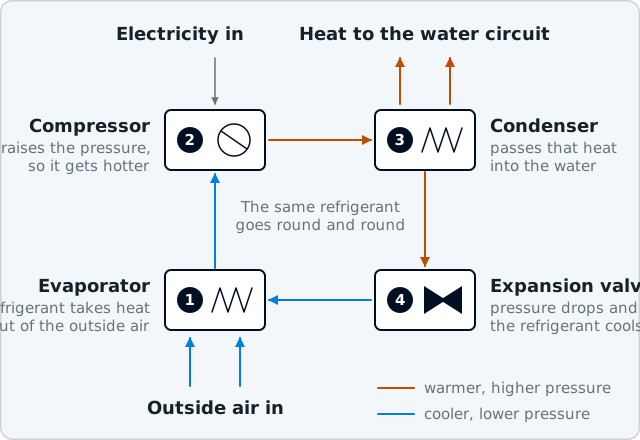
A boiler can usually mask a poorly matched heating system by pushing water round at 70 to 80 degrees. A heat pump generally works at lower flow temperatures, so the heating system has to be able to deliver enough warmth at that lower temperature. Typical heat pump designs aim for a flow temperature somewhere in the region of 35 to 50 degrees, depending on the property.
So “is my home suitable” really breaks down into five practical questions.
- How much heat does the house lose on a cold day?
- Can the radiators or underfloor heating give out that much heat at a lower water temperature?
- Is there a sensible place for the outdoor unit, with enough air flow and acceptable noise at the neighbours’ windows?
- Is there a workable hot-water storage arrangement, with space and practical pipe routes?
- Is the electrical supply adequate?
None of those questions is about whether you deserve a heat pump. They are all about the building.
Why it matters for your home
If a system is designed around honest answers to those questions, the result is a house that holds a steady temperature, a system that runs quietly at low output for long periods, and hot water that behaves normally.
If those questions are skipped, the usual outcome is a heat pump forced to run hotter than intended to compensate for undersized radiators or unaddressed heat loss. That is the single most common cause of disappointment. The heating still works, but it works harder than it needed to, and the household ends up feeling that the technology was the problem when the design was.
This is why Airwarm looks at the building first. A good heat-pump installation begins with the home, not the product. Airwarm checks the building, emitters, hot-water requirements, controls and practical installation details before making a recommendation.
Where the outdoor unit goes
The outdoor unit needs air, and it needs to be somewhere its sound is not a problem for you or for a neighbour. That is usually straightforward, and occasionally it is the constraint that decides the whole project.
A good position generally has free air flow, room to service the unit, a level base, somewhere for condensate to drain, and distance from bedroom windows on both sides of the boundary. The clearances themselves are not one rule for every heat pump: they depend on the equipment selected and its manufacturer’s installation instructions, so the final position is settled at survey and design.
What Airwarm checks
The Home Energy Assessment is a short set of questions about your property type, age, current heating, insulation, radiators, outdoor space and hot water. It is deliberately quick and does not ask for photographs at this stage.
The assessment gives one of three outcomes: likely suitable, needs a closer look, or potentially unsuitable. “Needs a closer look” is not a bad result. Nothing in your answers rules a heat pump out, but some of them need checking; the result explains which, and invites you to send us your assessment so we can look into them. “Potentially unsuitable” means your answers show a significant constraint, and the result explains what it is.
Where the signs are positive, a detailed survey follows. It records room dimensions, construction, insulation assumptions, emitters and the temperature they can work at, hot-water demand, cylinder options, outdoor unit positions, pipe routes, electrical supply and your own comfort priorities, and it produces a room-by-room heat loss calculation rather than an estimate from floor area. Every design is then reviewed before a proposal is issued.
Common questions
“Heat pumps only work in new builds.” Not true. Plenty of older houses heat well with a heat pump. What is true is that an older, less insulated house loses more heat, so it needs more heat delivered, which usually means larger emitters and sometimes fabric improvements first.
“You have to rip out all your radiators.” Usually not all of them. Radiator output depends on the temperature difference between the water and the room, so some existing radiators are already large enough for lower-temperature operation and some are not. It is normally a per-room answer, not a whole-house one.
“You need underfloor heating.” No. Underfloor heating is a good low-temperature emitter, but correctly sized radiators work perfectly well.
“My house is solid stone, so it is hopeless.” Solid-wall construction is common across Bradford, Leeds and Shipley and it does not rule a heat pump out. It does mean heat loss needs calculating properly, and the sensible order of work may be insulation or emitters first.
“If I fail the assessment, that is the end of it.” Not necessarily. A “potentially unsuitable” result means your answers show a significant constraint. The online assessment is a first check, not a final engineering determination, and it describes the building as it is today rather than giving a permanent verdict.
Next step
Start with the Home Energy Assessment. A quick first step to understand whether a heat pump is worth exploring for your property.
If the answers point to a constraint, you will be told what the constraint is and, where it can be resolved, what would resolve it, whether that is loft insulation, a hot water cylinder position, a change to one or two radiators, or agreement from a freeholder. If a heat pump genuinely is not the right next step for your property, you will be told that plainly, with the reason.
Frequently asked questions
Does the age of my house decide whether a heat pump will work?
No. Age is a clue, not an answer. What matters is the actual heat loss of the building and the capacity of the emitters, both of which are measured rather than assumed.
Do I have to insulate my whole house first?
Not necessarily. Insulation reduces the heat you need to deliver, which makes the whole system easier. Airwarm will say which improvements genuinely change the design and which make little difference.
Can I keep my combi boiler arrangement with no cylinder?
A heat pump normally needs a hot water cylinder. If there is no realistic space for a conventional cylinder, that is something to check rather than a reason to rule a heat pump out: Airwarm can consider compact thermal storage such as Sunamp instead. Whether that suits your home depends on how much hot water the household uses and on the design.
What if I live in a flat or a listed building?
Both are possible but both add steps: permission from a freeholder or managing agent for a flat, and listed building consent where a property is listed. Airwarm will tell you what would need to happen rather than guessing.
Read next
Heat loss explained
The calculation that decides the size of the heat pump and every radiator in the house.
Will I need new radiators?
Which of your existing radiators are already big enough, and which are not.
The Airwarm process
All eight stages, from first enquiry to ongoing support, with a decision point at each.
Start with your home, not a product
The Home Energy Assessment takes a few minutes, asks for no photographs at this stage and gives you an honest first view of whether an air source heat pump is worth exploring for your property.