
Likely suitable
Several positive indicators suggest a heat pump is worth exploring for your home.
Next: Submit your assessment and we review the property alongside your answers before advising whether a survey is worthwhile.
A quick first step to understand whether a heat pump is worth exploring for your property. Four short stages, a few minutes, no photographs needed at this stage and nothing to measure. You get an honest first view of where your property stands and what a sensible next step would be.
Your answers are worked out in your own browser. Nothing is sent to Airwarm unless you choose to send it using the form at the end.
Installations begin in April 2027. Desktop Reviews, surveys and design are happening now, so you can plan ahead for the launch.
This is an indicative first step, not a technical heat-loss survey. It does not produce a design, a specification or a price, and it is not a final answer — a person at Airwarm makes that judgement.
All four stages run entirely in your browser, and so does the result. Nothing you enter reaches Airwarm while you are working through it, nothing is saved to your device, and there are no cookies and no analytics on this website.
At the end you can fill in a short form to send us your answers and your contact details, so we can look at your property properly and come back to you. That is the only point at which anything is sent, it is entirely optional, and you can read your result and close the page instead. What happens to the details if you do send them is set out in our privacy policy.
We do not ask for pictures at this stage. Nothing to measure, nothing to look up.
Best guesses are genuinely fine, and “not sure” is a real answer rather than a failure. Where an answer is uncertain, the result says so.
Twenty-one short questions across three stages, then your result in stage four. You can go back and change any answer before you finish.
There is no pass and no fail. Each result is a first view based on your answers, not a final engineering judgement, and the blue and amber results explain why they came out that way using the answers you actually gave.
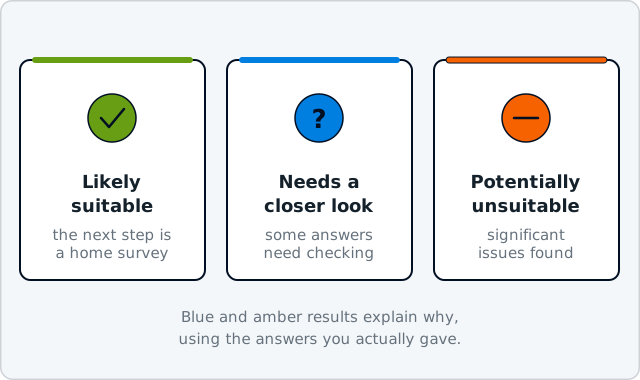
Several positive indicators suggest a heat pump is worth exploring for your home.
Next: Submit your assessment and we review the property alongside your answers before advising whether a survey is worthwhile.
Nothing rules a heat pump out, but one or more answers needs checking. Choosing “Not sure” counts as uncertainty, not a problem.
Next: Submit the assessment and we investigate those points in your Desktop Engineering Review.
One or more answers suggests a significant issue that could make an installation difficult or unsuitable. The assessment is an initial check, not a survey.
Next: We explain which answers triggered the result so you understand why we would not recommend progressing at this stage.
Plenty of people do not know how their walls are built or whether the loft was topped up. The assessment is designed to cope with that: uncertainty moves the result towards “needs a closer look” rather than counting as a problem with your home.
It cannot size a heat pump, tell you which radiators need changing, confirm where hot water would be stored, assess noise at a neighbour’s window or produce a price. All of that needs a survey, and the survey needs measurements rather than recollections.
Most homes can be heated well by a heat pump, though not every home today and not every home without changes. What actually decides it.
You will be shown which of your answers led to that result. It means those answers point to significant issues, not that a heat pump could never work: the online assessment is not a final engineering judgement. Based on the information given, though, we would not recommend going on to the next stage.
Your answers and your result stay in your browser. Nothing is saved and nothing reaches Airwarm while you work through the assessment, and closing the tab discards it.
After your result you can choose to send it to us using the optional form, which sends your assessment and contact details to Airwarm. That is the only point at which anything is sent. AIRWARM LTD is a registered company, and our privacy policy explains how we handle what you send.
No, and it is important that it is not mistaken for one. A survey measures every room, records the construction, measures the existing emitters and assesses siting, noise and the electrical supply. This is a triage tool that tells you whether that visit is likely to be worthwhile. Here is what a survey actually involves.
Answer “not sure”. It is offered on every question where uncertainty is normal, and the result accounts for it by telling you what needs checking rather than by assuming the worst.
You are welcome to run the assessment anyway — it will still tell you something useful about your property. Whether Airwarm can help you yet is a separate question, and the honest answer depends on where you are. Ask us and you will get a straight answer either way.
The Home Energy Assessment takes a few minutes, asks for no photographs at this stage and gives you an honest first view of whether an air source heat pump is worth exploring for your property.