
Hot water with a heat pump: cylinders, capacity and what changes
An air source heat pump heats hot water by warming a store rather than heating it instantly at the tap, so an installation needs somewhere to keep that hot water. A conventional cylinder is the usual answer; where one will not fit, compact thermal storage such as Sunamp can be considered instead. Finding a workable position for whichever suits is one of the first practical questions a survey has to answer.
What it actually means
A combi boiler heats water on demand. You open a tap, the boiler fires hard for as long as it is open, and it delivers a continuous stream at high power. A heat pump cannot work that way, because its output is modest and steady rather than sudden and large.
Instead, a heat pump heats a cylinder of water in advance, usually at a time of day chosen deliberately, and the household draws from that store. When the store is depleted, the heat pump reheats it.
Two features distinguish a heat pump cylinder from an older boiler cylinder.
The first is the coil, the heat exchanger inside the tank. Because the heat pump supplies water at a lower temperature than a boiler, the coil needs much more surface area to transfer heat quickly enough. Cylinders designed for heat pumps typically have a coil area of around three square metres or more, where older boiler cylinders were often well under one. An old cylinder is usually not suitable even if it looks serviceable.
The second is insulation. Modern cylinders are far better insulated, which matters because the water is stored rather than made on demand.
Most installations use an unvented cylinder, which is fed at mains pressure and gives balanced pressure at hot and cold taps. Unvented cylinders are covered by Part G of the Building Regulations and must be installed and commissioned by someone competent to do so.
Why it matters for the outcome in your home
Three things follow from the cylinder decision, and households notice all of them.
| Factor | What it depends on |
|---|---|
| Capacity — whether you run out | How the household actually uses hot water: how many people, how many bathrooms, whether anyone takes long showers, and whether demand is concentrated in one part of the day. |
| Reheat time — how quickly the store recovers | The coil area, the heat pump output and the temperature the cylinder is heated to. |
| Timing — when the heat pump does the work | Because a store can be filled in advance, hot water heating can often be scheduled to suit the household’s routine and its electricity tariff. What that is worth depends entirely on your tariff and usage, so it is something to plan rather than something to promise. |
Where a cylinder can realistically go
Space is the constraint that most often decides the answer. A cylinder takes up real room, typically in an airing cupboard, a bedroom cupboard, a loft with adequate access and support, or a utility area.
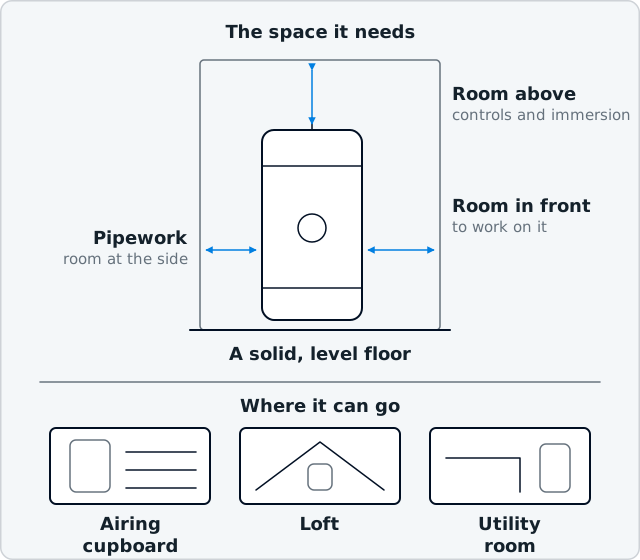
If there is genuinely nowhere for a conventional cylinder, Airwarm will explain that constraint clearly. That is not the end of the conversation — cylinders come in a range of shapes and footprints, a survey often finds a position the household had not considered, and where none works Airwarm can consider compact thermal storage such as Sunamp. Whether that suits a home depends on its hot-water demand and the system design, so it is never promised in advance.
What Airwarm checks
The survey records your hot water demand and how the household uses it, not just the number of bedrooms. It records candidate cylinder positions and assesses each for access, structural support, pipe routes, the discharge arrangement an unvented cylinder requires, and the practicalities of servicing it later.
It also records the incoming mains flow rate and pressure, because an unvented cylinder depends on the mains supply. A weak incoming main is worth knowing about before anything is ordered.
Airwarm considers how legionella control will be handled. Stored water needs a periodic higher-temperature cycle to manage bacterial risk, using either an immersion heater or the heat pump itself. The frequency and temperature follow the manufacturer’s instructions and relevant guidance, and the configuration is set at commissioning and explained at handover.
Hot water performance is tested at commissioning, alongside the flush, pressure test, filters and strainers, controls, weather compensation, emitter balancing, noise check and handover.
Common questions
“Heat pump hot water is lukewarm.” A correctly configured cylinder stores water at a normal usable temperature. What is different is that the store is finite, so an unusually heavy sequence of showers can deplete it before it recovers. That is a sizing question, and it is why the survey asks about your routine.
“I can keep my existing cylinder to save work.” Usually not. The coil in most existing cylinders is too small for low-temperature operation, so keeping it tends to force the heat pump to run hotter and slower than it should.
“You can get a heat pump that works like a combi.” Some arrangements reduce the storage requirement, but the underlying physics does not change. A design that removes storage entirely is normally leaning on direct electric heating for hot water, and that should be stated openly rather than presented as a feature.
“I have no airing cupboard so a heat pump is out of the question.” Not necessarily. Cylinders come in a range of shapes and footprints, and a survey often finds a position the household had not considered. But if there is genuinely no viable location, that is a genuine design constraint and we will explain it clearly.
Next step
Start with the Home Energy Assessment. It asks about your hot water arrangement and your available space, which is enough to flag whether this is likely to be a straightforward part of the project or the main question.
A quick first step to understand whether a heat pump is worth exploring for your property.
If you currently have a combi boiler and no cylinder space, say so clearly. It does not automatically rule you out, but it moves the cylinder question to the front of the survey rather than the middle.
Frequently asked questions
How big a cylinder will I need?
It depends on the number of occupants, bathrooms and your usage pattern rather than a standard figure. The survey sizes it, and Airwarm will explain the reasoning rather than simply stating a volume.
Does the cylinder need servicing?
Yes. Unvented cylinders have safety components that should be checked as part of routine servicing, and this forms part of Airwarm’s annual service scope.
Can the heat pump heat the cylinder and the radiators at the same time?
Most systems prioritise one at a time, switching to hot water for a period and then returning to heating. In practice this is not usually noticeable, and the scheduling is part of the commissioning setup.
Read next
Is my home suitable?
Cylinder space is one of the five questions. Here are the other four.
What determines running costs
How scheduling hot water into a chosen period interacts with your tariff.
What a survey covers
Including mains flow and pressure, candidate cylinder positions and discharge routes.
Start with your home, not a product
The Home Energy Assessment takes a few minutes, asks for no photographs at this stage and gives you an honest first view of whether an air source heat pump is worth exploring for your property.