
Weather compensation explained: why heat pumps should not be switched on and off
Weather compensation means the heat pump automatically adjusts how hot the water going to your radiators is, based on how cold it is outside. It is the main reason a well set-up heat pump runs steadily at a low temperature instead of blasting and stopping, and it is one of the most commonly misconfigured parts of a system.
What it actually means
A boiler traditionally worked to a single fixed water temperature. Whether it was two degrees outside or twelve, it sent water out at the same temperature and relied on the room thermostat to interrupt it when the house got warm enough. Heat, then stop, then heat again.
Weather compensation replaces that with a sliding relationship. An outdoor sensor measures the air temperature, and the heat pump calculates the water temperature the house needs at that moment. On a mild day the flow temperature might be quite low. On the coldest day of the year it rises to the design figure.
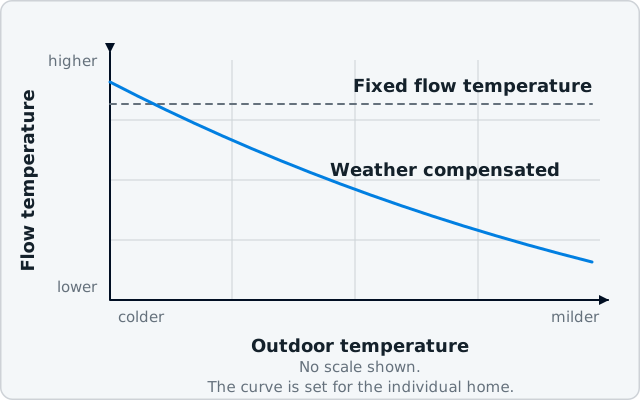
The relationship between outside temperature and flow temperature is called the compensation curve, or heating curve. Setting it is a design decision: it comes from the heat loss calculation and the emitter capacity, then it is refined against how the house actually behaves.
COP, SCOP and why flow temperature drives both
This matters because a heat pump’s efficiency depends heavily on the flow temperature it is producing. The smaller the gap between outside air and heating water, the more heat it moves for each unit of electricity. So a system that produces only the temperature genuinely required, rather than the maximum all the time, is doing something useful.
That efficiency figure is called COP, or coefficient of performance: the ratio of heat delivered to electricity used at a given moment. SCOP is the seasonal version. Both are ratios rather than promises, and both move with flow temperature, outdoor temperature and how the system is run.
Why it matters for the outcome in your home
Two things change noticeably when compensation is set up well.
The first is comfort. A house heated by a steady, low-temperature output tends to sit at a consistent temperature rather than swinging between too warm and slightly chilly.
The second is how the equipment behaves. A heat pump asked to produce the maximum temperature and then stop will short cycle: frequent starts and stops, more wear, more noise, and worse efficiency than the same unit running gently for hours.
There is a trade-off to be honest about. Compensation works best with continuous or near-continuous operation, so the heating is often on for far longer than people are used to, at a much lower intensity. Households find that counterintuitive, and it needs explaining rather than simply configuring and leaving.
What Airwarm checks and does about it
The compensation curve starts as a design output, not a factory default. It is derived from the room-by-room heat loss calculation, the emitter schedule and the design flow temperature the system was sized around.
Setting weather compensation is a specific item on Airwarm’s commissioning checklist, alongside the flush, pressure test, filters and strainers, controls, emitter balancing, hot water test and noise check. It is recorded, not left implicit.
-
Contact within 48 hours
A first check that the system is behaving as expected once you have lived with it for a couple of days.
-
Comfort review at two weeks
The curve usually benefits from adjustment once the household has actually used the house through a few different days of weather.
-
Seasonal optimisation where required
A setting that works in October is not automatically the right one in January.
-
Annual service and optimisation
Controls and compensation are checked, so a system running hotter than it needs to is picked up rather than left.
Handover includes explaining how your controls are meant to be used. A system that is technically correct but operated like a boiler will not perform as designed, and that is a communication failure rather than a customer error.
Common questions
“Turning the heating off when I am out saves energy.” With a boiler this often helped. With a heat pump the picture is mixed, because recovering a cooled house means running at higher output and higher temperature for a period, which is where a heat pump is least efficient. A deep setback in a house with high heat loss frequently costs more than it saves. Worth testing in your own home rather than assuming either way.
“Weather compensation means I have no control.” You still set the temperature you want. What compensation removes is the need for you to decide the water temperature, which was never a useful thing to manage manually.
“A room thermostat is unnecessary with weather compensation.” Most systems use both: compensation sets the water temperature, and a room sensor provides a reference and a limit so the house does not overheat in sunshine. How they are combined varies by manufacturer.
“Setting the curve higher makes the house warmer, so higher is better.” It makes the house warmer sooner, at the cost of efficiency, and it can mask an undersized emitter rather than fix it. If a room is not reaching temperature, the honest first question is whether its emitter is large enough.
“Once it is set, it never needs touching.” Curves usually need refinement in the first season. That is why the two-week and seasonal reviews exist.
Next step
If you are considering a heat pump, start with the Home Energy Assessment. Clear advice, careful surveying, transparent design, respectful installation and long-term support.
If you already have a heat pump installed by someone else and suspect it is running hotter than it should, Airwarm’s servicing and optimisation work covers controls and weather compensation. E-mail hello@airwarm.co.uk and describe what the system is doing.
When comparing proposals, ask each installer what design flow temperature they have assumed and how they arrived at the compensation curve. An installer who can answer that from their heat loss calculation is working from evidence.
Frequently asked questions
Do all heat pumps have weather compensation?
Effectively all modern heat pumps support it, but it is not always enabled or set correctly. Whether it has been configured deliberately is a fair question to ask any installer.
Will my house take longer to warm up?
A heat pump raises temperature more gradually than a boiler. In normal operation the house should not need warming up, because it is held at temperature rather than allowed to fall and then recovered.
Can I still use a timer?
Yes, and many households use a gentle overnight reduction rather than switching off entirely. Airwarm will explain what suits your building, because a well-insulated house and a solid-wall house behave differently.
Read next
What determines running costs
Flow temperature is the biggest lever a designer has. Here is the rest of the picture.
Common problems and causes
Why a misconfigured curve is behind so many complaints, and what can be corrected later.
The Airwarm process
Where commissioning, handover and the two-week comfort review sit in the sequence.
Start with your home, not a product
The Home Energy Assessment takes a few minutes, asks for no photographs at this stage and gives you an honest first view of whether an air source heat pump is worth exploring for your property.